
The Ultimate Event Ticketing Platform Checklist for 2027
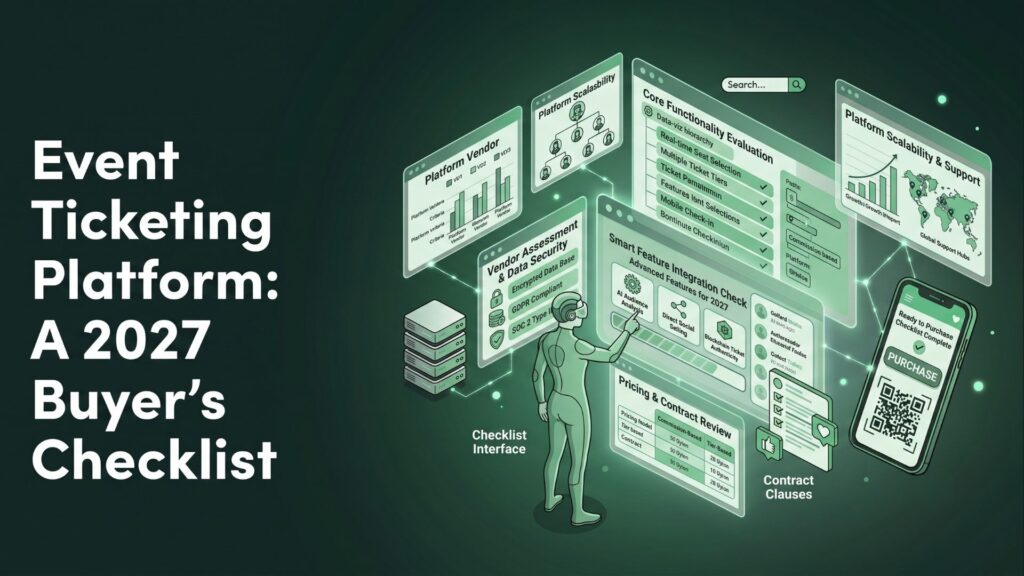
Event Ticketing Platform: A 2027 Buyer's Checklist
Overview
Most event ticketing platforms look identical on the surface. They all promise a fast setup, a clean checkout, and “low fees.” The differences that actually decide your revenue and your event-day stress are the ones the demo never shows you: what the platform does in the worst hour of your biggest on-sale, how fast your money lands, and who owns the buyer relationship after the show.
This is a 2027 buyer’s checklist for choosing an event ticketing platform. It is a scoreable, ten-point framework you can drop straight into a vendor RFP. Instead of scoring platforms on the features that make them look alike, it scores them on the structural decisions that are expensive to reverse once you have signed.
We built it from live operations, not theory. Ticmint runs the full spectrum on one system, from free self-serve events to high-demand sports on-sales like the Yonex-Sunrise India Open 2026, which delivered a 3X marketing ROAS (Ticmint, 2026). The pillars below are what separate a platform that scales from one that stalls out.
What Is an Event Ticketing Platform?
An event ticketing platform is software that lets organizers create ticket types, sell them online and at the door, take payment, check attendees in, and report on the results. The main differences between platforms come down to two questions: who owns the checkout experience, your brand or the platform’s, and who owns the attendee data afterward.
Why Your 2027 Event Ticketing Platform Choice Matters More Than the Demo
Choosing an event ticketing platform is a two-to-three-year commitment, not a one-event purchase. The structural terms compound quietly, and the cost of choosing badly rises every year as ticket volumes and buyer expectations climb.
Consider what actually leaks value over a contract:
- Fees compound against volume. A 5% gap in platform fees on $500,000 of ticket sales is $25,000. That money either stays in your event budget or goes to the vendor.
- Slow payouts are a cash-flow problem with a discount attached. A “low” fee that sits on your revenue for 14 to 30 days after the event is not actually cheap.
- Data you don’t own resets your marketing to zero. A database you control can be re-engaged for the next event at a fraction of cold-acquisition cost. A database the platform controls cannot.
- Migration is painful. A flashy feature can be added later. A rigid fee model and a platform that owns your buyers are much harder to escape once you are in.
This means the smart evaluation question is not “what features does it have,” but “what happens when volume spikes, when a refund goes wrong, or when I need my money faster than the default schedule.”
How to Use This Buyer's Checklist
Score each platform on your shortlist from 1 to 5 on every pillar, then multiply by the weight in the scorecard table further down. Weight the structural criteria (fees, data ownership, compliance) more heavily than the cosmetic ones, because they are the hardest to change after you commit.
Each pillar below ends with the exact question to put in your tender document. Ask it verbatim. A vendor that resists a plain question is telling you the answer.
The 10-Point Event Ticketing Platform Checklist for 2027
1. Pricing and Payout Speed
Ask for the all-in number, not the headline fee, and pair it with the payout schedule. Percentage-of-price models get most expensive exactly as you grow, so run the pricing against your real attendance and ticket prices, not a generic estimate. As a benchmark, Ticmint’s transaction fees start at 2%, compared with Eventbrite’s standard 3.7% + $0.79 per ticket in the US, while some platforms bill white-label branding as a separate monthly add-on. Payout speed belongs on the same line: money you can’t touch for a month is not revenue yet.
Ask the vendor: What is the all-in per-ticket cost, and how many days after the event do payouts land?
2. Peak-Demand and On-Sale Reliability
The first real test of any platform is the worst minute of its biggest sale. An uptime percentage on a marketing page is not evidence. Look for documented load testing, fair queuing that holds buyers in line instead of timing them out, and clear behavior when a payment fails mid-transaction so a seat is released rather than double-booked.
Ask the vendor: Can you show load-testing data or a comparable past on-sale, and what happens to a seat if a payment fails mid-checkout?
3. Attendee Data Ownership
Data ownership deserves its own line item, never an assumption. On marketplace platforms the buyer often belongs to the platform, which can then market competing events to the audience you paid to acquire. Owned data compounds: it is next year’s remarketing list, the lookalike audience that lowers your ad costs, and the proof a sponsor wants to see.
Ask the vendor: Can I export my full attendee database, with contact details and consent records, at any time, self-serve, and install my own tracking pixels?
4. Branding and White-Label Control
Decide whether buyers experience your brand or the platform’s. A true white-label setup carries your logo, domain, and payment gateway across every touchpoint, from event page to QR ticket to confirmation email. In contrast, a marketplace checkout puts the platform’s brand and emails between you and your buyer at the moment of purchase.
Ask the vendor: Is the checkout on my own domain and branding, or the platform’s, and is white-labeling included or an add-on?
5. Access Control and Box Office
Online sales and on-site issuance should reconcile in one dashboard, not two data sources you compare after the event. Look for fast QR check-in that rejects duplicated or screenshotted tickets at the gate, plus a box office that issues and refunds on the spot. This means your door team and your online team are reading the same numbers in real time.
Ask the vendor: Do box office and online sales reconcile in a single report, and how does check-in reject duplicate tickets? See how Ticmint handles access control setup.
6. Reserved Seating and Inventory Integrity
For seated venues and tiered events, inventory integrity is non-negotiable. The platform must hold seats accurately under load, support tiered ticket types with capacity caps, and handle phase moves from early-bird to standard to VIP without a support ticket. Organizers should be able to change phases and pricing mid-sale directly from the dashboard.
Ask the vendor: Can I move ticket phases and adjust pricing mid-sale myself, and how is a reserved seat protected from double-booking during a spike?
7. Multi-Market Compliance (KYC and Payouts)
If you sell across borders, or plan to, compliance is a platform feature, not your problem to solve manually. Selling into the US, UK, India, and the UAE each carries its own KYC and payout rules. A platform with built-in multi-market support means one system instead of a workaround per market. This is where many otherwise-capable platforms quietly fall down.
Ask the vendor: Do you support KYC and compliant payouts natively in every market I sell in, including US payout compliance, or is that on me?
8. Marketing and Integrations
A ticketing platform is also a demand engine. Look for built-in email and promo tools, affiliate and referral tracking, and clean connections to your CRM and ad platforms. The point is not the length of the integration list. It is whether the tools remove steps from how you already sell.
Ask the vendor: Which marketing tools are built in, and does the platform connect to my CRM and ad accounts without custom development?
9. Reporting and Reconciliation
Live reporting should answer the two questions you actually ask during a sale: who is buying, and where are they coming from. After the event, settlement and sales data should reconcile without a spreadsheet exercise. For example, order history and refunds should be traceable per transaction, not summarized into totals you can’t audit.
Ask the vendor: Does reporting update live during a sale, and do settlement records reconcile against sales automatically? Review how order history is structured.
10. Implementation and Support
A platform can tick every box and still fail you if no one answers when something breaks on a Saturday night. Weigh onboarding speed and the support model heavily, especially for high-volume or complex events. For reference, the Basketball Federation of India (BFI) went live within 24 hours of onboarding for its FIBA qualifier window (Ticmint, 2026).
Ask the vendor: What is realistic time-to-live for my first event, and what does support coverage look like during an active on-sale?
Event Ticketing Platform Scorecard: Weighting the 10 Criteria
Score each shortlisted platform 1 to 5 per pillar, multiply by the weight, and total the column. The structural pillars carry the most weight because they are the hardest to reverse.
# | Criterion | Weight | Platform A (1 to 5) | Platform B (1 to 5) |
|---|---|---|---|---|
1 | Pricing & payout speed | ×3 | ||
2 | Peak-demand reliability | ×3 | ||
3 | Attendee data ownership | ×3 | ||
4 | Branding / white-label | ×2 | ||
5 | Access control & box office | ×2 | ||
6 | Reserved seating & inventory | ×2 | ||
7 | Multi-market compliance | ×3 | ||
8 | Marketing & integrations | ×1 | ||
9 | Reporting & reconciliation | ×2 | ||
10 | Implementation & support | ×2 | ||
Weighted total (max 115) |
Red Flags to Watch for in 2027
Some answers should end a vendor conversation early. Watch for these:
- Data co-ownership clauses. If the vendor can contact your buyers “for any reason, ever,” the data is not really yours.
- Payout holds framed as normal. A default 14 to 30 day hold on your money is a choice, not a law of physics.
- White-label sold as a premium tier when your buyers should never see the platform’s brand at all.
- Uptime claims with no load-test evidence. Ask for the receipts; a real platform has them.
- Export by support ticket. If getting your own data out requires a request queue, you don’t control it.
How Ticmint Scores on This Event Ticketing Platform Checklist
Ticmint was built around the structural pillars, not the cosmetic ones. Here is how the platform maps to the checklist, with the consequence attached to each.
Checklist pillar | What Ticmint does | Which means |
|---|---|---|
Pricing & payout | Transaction fees from 2%, with access control and order management included, not billed as add-ons | More of each sale stays in your budget |
Data ownership | Every buyer is exportable at any time | Re-engage your audience next event instead of a cold start |
Branding | Full white-label checkout on your own domain (Growth plan) | Buyers never see Ticmint |
Box office | On-site issuance and online sales reconcile in one dashboard | One source of truth, not two |
Phase control | Move phases and pricing mid-sale from the dashboard | No support ticket to change a price |
Compliance | Built-in KYC and payout support across the US, UK, India, and UAE | One system across markets, not a per-market workaround |
Ticmint powers 1,600+ events, 820K+ fans, and $41M+ in transactions across 138 countries (Ticmint, 2026), spanning self-serve creators through national federations and government events such as ITFOK (Government of Kerala). Clients include the Badminton Association of India (BAI), the Basketball Federation of India (BFI), The Times Group, and Peak Longevity Fest.
For a deeper walkthrough, see How to Choose a Ticketing Platform (2026 Guide) and Event Ticketing Software: What to Look For in 2027. Enterprise buyers can request a requirements assessment on the enterprise ticketing solution page.
Frequently Asked Questions (FAQs)
1. What is an event ticketing platform and how does it work?
An event ticketing platform is software that lets organizers create ticket types, sell them online and at the door, take payment, check attendees in, and report on sales. Platforms differ mainly in who controls the branded checkout and who owns the attendee data captured during purchase.
2. How much does an event ticketing platform cost in 2027?
Cost has two parts: the per-ticket fee and the hidden cost of slow payouts and locked data. Headline fees range from flat monthly subscriptions to percentages of ticket price. Ticmint’s transaction fees start at 2%. Always compare the all-in number, including payout timing, against your real ticket volume.
3. What should I look for in an event ticketing platform?
Look past the feature list at the model underneath: how fees are structured, how fast you get paid, whether you own the buyer data, whether it runs your door as well as online sales, and what support looks like when something breaks. Score the structural factors highest, because they are hardest to change later.
4. Who owns the attendee data on an event ticketing platform?
It depends on the contract, so treat it as a negotiated term. On marketplace platforms the buyer often belongs to the platform, which can market competing events to them. Choose an event ticketing platform that lets you export full attendee records, with consent data, self-serve at any time.
5. What's the difference between a ticketing platform and a marketplace?
A marketplace owns the checkout, the buyer relationship, and often the data, and typically charges higher per-ticket fees. A white-label platform is infrastructure: you own the brand, the buyer data, and the marketing relationship, and buyers never see the platform. The trade-off is marketplace “discovery” versus control.
6. What questions should I ask an event ticketing platform vendor?
Ask the all-in per-ticket cost and payout timing, whether you can export full attendee data at any time, whether the checkout is on your domain, how the system behaves during a peak on-sale, and what support coverage looks like during a live event. Plain answers signal a fair vendor.
7. Is Ticmint available in the US, UK, India, and the UAE?
Yes. Ticmint supports organizers across the US, UK, India, and the UAE, with built-in KYC and compliant payout handling in each market, including US payout compliance. This means cross-border selling runs on one system rather than a manual workaround for every country.
Score Your Shortlist with Ticmint
Run every platform on your shortlist through the ten pillars above, then see how Ticmint scores against them. Start free at ticmint.com to build a branded event in minutes, or request an enterprise assessment to walk your requirements against the platform pillar by pillar.
Ticmint is a white-label event ticketing platform powering 1,600+ events and $41M+ in transactions across 138 countries. Published September 2026.
Want to see how Ticmint works for your event?
Talk to our enterprise team. Most clients are live within 2–4 weeks.
Running events?
Build experiences people remember, and own every part of it.
- Your brand, your experience- fully white-labeled
- Save up to 35% on platform fees
- Own your data-audience, revenue & insights, all yours
This will redirect you to WhatsApp chat 🙂
Subscribe to our newsletter
Get fresh ideas, expert insights, and actionable strategies for memorable events, delivered straight to your inbox!