
The Best Event Ticketing Platform and Software in 2026
The Best Event Ticketing Platform and Software in 2026
Overview
Most event organisers don’t realise they have a data problem until it’s too late.
You sell 5,000 tickets. The event is a success. Then you go to plan the next one, and you can’t contact a single person who attended. The ticketing platform owns that audience. You just paid to build someone else’s database.
This is the fundamental problem with most event ticketing software: you’re renting access to your own attendees.
This guide covers the best event ticketing platforms in 2026, what they do well, what they don’t, and how to choose the right one based on your event type, volume, and growth goals.
What Makes a Great Event Ticketing Platform in 2026
Before comparing options, here’s what separates a good ticketing tool from a great one:
- Audience ownership: You should be able to export all attendee data, emails, phone numbers, and purchase history at any time. If you can’t, you’re building on rented land.
- White-label ticketing experience: Your attendees should see your brand at every touchpoint, from the event page to the checkout to the confirmation email. A checkout page that says “Powered by [Platform Name]” is a brand experience leak.
- Built-in marketing tools: Email automation, WhatsApp reminders, cart recovery, and post-event follow-ups shouldn’t require a separate tool.
- Transparent pricing: A 10% platform fee on a $50 ticket is $5 per sale, which compounds fast on high-volume events.
- Real-time reporting: You need to see sales velocity, capacity utilisation, and revenue breakdowns during the event, not three days after.
Types of Event Ticketing Software
Not all ticketing software solves the same problem. There are three main categories:
Marketplace platforms
Platforms like Eventbrite, BookMyShow, and Ticketmaster operate as marketplaces. They list your event alongside thousands of others. The benefit: built-in discovery. The cost: they own your audience data, charge higher fees (typically 6–10%+), and your event competes for attention on their platform.
Best for: one-off public events where discovery matters more than ownership.
Self-serve ticketing tools
Platforms like TicketTailor and Tixr give you more control and lower fees, but offer limited marketing automation, minimal white-label options, and basic analytics.
Best for: small independent creators and community organisers who need simple, affordable ticket sales.
White-label event ticketing platforms
A white-label platform gives you a fully branded ticketing experience, your domain, your design, your payment gateway, plus built-in marketing automation, audience data ownership, and enterprise-level reporting.
Best for: professional event organisers, sports federations, recurring event businesses, and any organiser serious about audience growth.
The Best Event Ticketing Platforms in 2026
1. Ticmint: Best for Organisers Who Want Full Control
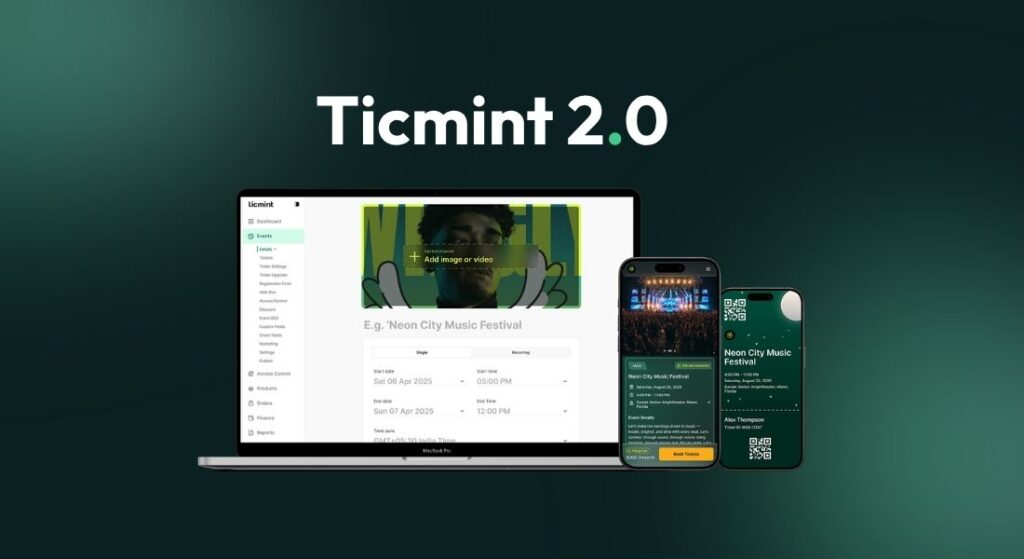
Ticmint is a white-label event ticketing platform built for organisers who want to own every part of the event experience, brand, audience data, marketing, and revenue. Originally built as enterprise event infrastructure, Ticmint is now available to events of all sizes, from independent creators to international sports federations.
What makes it different:
- True white-label ticketing experience: Custom domain, branded checkout, your payment gateway, your WhatsApp sender name. Attendees never see Ticmint.
- Built-in marketing automation: Email and WhatsApp workflows triggered by order events, confirmations, reminders, cart recovery, and post-event feedback. No Mailchimp or Klaviyo required. Explore our Event Marketing tools.
- Audience ownership: Full attendee database export at any time. You own the data, not the platform.
- Interactive seat maps: Branded, zoned seating with real-time inventory sync and flexible access rules.
- Real-time analytics: Metabase-powered dashboards, sales velocity, capacity utilisation, revenue by ticket type, and add-on performance.
- Revenue maximisation: Add-ons marketplace (F&B, parking, merch), dynamic pricing, upsell engine, and a Refund Guarantee product that generates 4–6% additional revenue.
Pricing: Starts at 2% per transaction. Full white-label experience available from ₹249/$19/£19 per month. Free plan available for smaller events.
Proof at scale:
- The Yonex-Sunrise India Open, India’s largest badminton tournament, ran on Ticmint for two consecutive seasons. Combined results: 27,000+ tickets sold, 1M+ new users acquired, 138 countries reached, 3X marketing ROAS, and +27% revenue growth year-on-year.
- Peak Longevity Fest in Dubai, a premium wellness festival, saw 3.1X revenue growth year-on-year using Ticmint, with VIP sold out and a 10/10 NPS score.
Best for: Sports organisations, music festivals, cultural events, corporate events, and any professional organiser running recurring events.
2. Eventbrite: Best for Discovery-Driven One-Off Events
Eventbrite is the world’s largest event marketplace. If you’re running a public event in a major city and want organic discovery from the platform’s existing user base, Eventbrite has value.
What you give up: Attendee data belongs to Eventbrite. There is no white-label option; your checkout and event page are Eventbrite-branded regardless of plan. Fees are typically 3.7%–6.4% of the ticket price plus a flat charge per ticket. You’re one listing among thousands.
Best for: Community events, networking evenings, and one-off workshops where discovery outweighs ownership.
3. TicketTailor: Best for Budget-Conscious Independents
TicketTailor charges a flat fee per ticket rather than a percentage, which makes it cost-effective for higher-priced events. Setup is fast and the interface is clean.
What you give up: White-label features cost an additional $49/month on top of the base plan. No built-in email or WhatsApp marketing automation. No dynamic pricing. Analytics are basic. By comparison, Ticmint’s full white-label experience starts at ₹249/$19/£19 per month, with automation included.
Best for: Independent creators and small community organisers selling under 500 tickets per event.
4. Ticketmaster / Live Nation: Best for Arena-Scale Events
Ticketmaster handles stadium and arena events at a scale no other platform can match. For a 50,000-seat concert, it’s the default choice.
What you give up: Fees are among the highest in the industry. Ticketmaster owns your audience. You have minimal control over the checkout experience or attendee data.
Best for: Large-scale entertainment events at established venues already integrated with Ticketmaster’s systems.
5. vivenu: Best for Tech-Forward Organisers

vivenu is a white-label ticketing platform popular in Europe, especially Germany. It has strong API capabilities and good developer documentation.
What you give up: Contract values typically start in the thousands of dollars, making it inaccessible for smaller or mid-size organisers. Limited managed services; you need an in-house technical team to get the most from it. Less proven in India, the UAE, and emerging markets. WhatsApp integration and local payment gateways are not as mature.
Best for: Funded European organisations with technical teams building custom ticketing infrastructure.
Event Ticketing Software for Specific Verticals
Festival ticketing platform
Festivals need more than ticket sales. You need multi-zone access control (Main Stage vs VIP vs Backstage), F&B and merchandise add-ons, staged release pricing (early bird → general → door), and real-time capacity management across zones.
The best festival ticketing software combines a white-label checkout with built-in add-on management and dynamic QR codes that prevent fraud and duplication. A single QR code should unlock ticket + parking + F&B credits + zone access, no manual checks.
Sports ticketing software
Sports organisations face a specific challenge: many have historically given entry away for free. Converting to paid ticketing requires a platform that handles pricing strategy, seat maps, affiliate marketing for clubs and associations, and post-event data for remarketing.
The Yonex-Sunrise India Open is the clearest proof of what’s possible: two consecutive seasons of structured paid ticketing on a tournament that was previously free, resulting in 27,000+ tickets sold, 1M+ new users in the database, and 3X ROAS on marketing spend.
Online event ticketing software for India
The Indian events market has specific requirements: WhatsApp is the primary communication channel (not email), Razorpay and UPI are the dominant payment methods, and local language support matters for regional audiences.
The best event ticketing platform for India combines Razorpay/UPI payment integration with WhatsApp automation, regional pricing flexibility, and real-time reporting. Ticmint’s full white-label access starts at $19/month, making it accessible for Indian organisers at any scale.
The Hidden Cost of the Wrong Ticketing Platform
Most organisers compare platforms on headline fee percentages. That’s the wrong metric.
The real cost is the audience you don’t own.
If you sell 10,000 tickets at $50 each through a marketplace platform, you generate $500,000 in revenue. But after the event, you have no database. Your next event starts from zero. You pay to acquire the same audience again.
If you run the same event on a white-label platform, you leave with:
- 10,000 verified attendee contacts (email + phone)
- Purchase history and ticket type data for segmentation
- A remarketing audience for your next event
A 5% difference in platform fees on $500,000 is $25,000. A re-engagement campaign to your own database costs almost nothing and typically converts at 2–5X the rate of cold acquisition.
Audience ownership is worth more than fee savings.
How to Switch Event Ticketing Platforms Without Losing Momentum
Switching ticketing software mid-season feels risky. It doesn’t have to be.
The cleanest approach:
- Set up your new platform before your next event announcement
- Import any existing contacts into your new attendee database
- Configure your branded checkout and automation workflows before going live
- Redirect traffic from old ticketing pages to your new event page
- Run one event end-to-end on the new platform before decommissioning the old one
Ticmint’s onboarding typically takes under 48 hours for a standard event setup. For enterprise migrations with complex seat maps and multiple integrations, the implementation team handles the full transition.
What to Look for in Event Ticketing Software: Checklist
Before you commit to a platform, ask these questions:
- Can I export my full attendee database at any time?
- Is the checkout page branded with my logo and domain, or the platform’s?
- Does it include email and WhatsApp automation, or do I need separate tools?
- What are the total fees, including per-ticket charges, payment processing, and subscription costs?
- Does it support dynamic QR codes that prevent ticket fraud and duplication?
- Can I add F&B, parking, or merchandise as upsells during checkout?
- Does it integrate with Meta Pixel, Meta Conversions API, and GA4 for attribution?
- Is there a mobile scanning app for on-the-door access control?
Frequently Asked Questions (FAQs)
1. What is the best event ticketing platform in 2026?
The best event ticketing platform depends on your priorities. For full audience data ownership, white-label branding, and built-in marketing automation, Ticmint is the strongest option for professional organisers. For one-off public events where discovery matters, Eventbrite works well. For budget-conscious independent creators, TicketTailor is a cost-effective starting point.
2. What is the difference between an event ticketing platform and a ticketing marketplace?
A ticketing marketplace (like Eventbrite or BookMyShow) lists your event alongside thousands of others. The platform owns your attendee data and charges higher fees. A white-label event ticketing platform gives you your own branded checkout, attendee data ownership, and marketing automation; you control the full experience.
3. How much does event ticketing software cost?
Event ticketing software costs vary significantly. Ticmint starts at 2% per transaction with a full white-label experience from ₹249/$19/£19 per month. Eventbrite charges 3.7–6.4% plus a flat fee per ticket. TicketTailor charges a flat fee per ticket but adds $49/month for white-label features. Vivenu’s contracts typically start in the thousands of dollars.
4. Does Eventbrite offer white-label ticketing?
No. Eventbrite does not offer white-label ticketing on any plan. Your event page and checkout will always display Eventbrite branding. For a fully branded ticketing experience, organisers need a dedicated white-label platform.
5. What is white-label event ticketing?
White-label event ticketing means the entire ticketing experience, event page, checkout, confirmation emails, QR codes, and scanning app, is branded with the organiser’s identity, not the platform’s. Attendees see only the organiser’s logo and domain. White-label ticketing gives organisers full brand control and ensures all audience data stays with them.
6. Which event ticketing platform is best for sports organisations?
Ticmint is the leading event ticketing platform for sports organisations. It powered two consecutive seasons of the Yonex-Sunrise India Open, India’s largest badminton tournament, generating 27,000+ tickets sold, 1M+ new users, and 3X marketing ROAS. It supports multi-zone access control, seat maps, dynamic pricing, and WhatsApp automation suited to sports events.
7. Can I switch ticketing platforms without losing my audience data?
8. What is the cheapest event ticketing software?
The cheapest event ticketing software depends on event size and volume. Ticmint offers a free plan for smaller events. TicketTailor offers flat-fee pricing from $0.65 per ticket but charges $49/month for white-label features. Eventbrite’s free plan charges higher per-ticket fees. For organisers prioritising value, Ticmint’s $19/month white-label plan offers the most features per dollar.
Conclusion
he best event ticketing platform in 2026 is the one that treats you, the organiser, as the customer, not the product.
That means full attendee data ownership, a white-label ticketing experience, built-in marketing automation, and transparent pricing that scales with your events.
Every event you run on a marketplace platform is an event where someone else is building the audience database. Enterprise-grade event infrastructure is now available to every organiser, you don’t need a stadium contract or a six-figure budget to own your audience.
Want to see how Ticmint works for your event?
Talk to our enterprise team. Most clients are live within 2–4 weeks.
Running events?
Build experiences people remember, and own every part of it.
- Your brand, your experience- fully white-labeled
- Save up to 35% on platform fees
- Own your data-audience, revenue & insights, all yours
This will redirect you to WhatsApp chat 🙂
Subscribe to our newsletter
Get fresh ideas, expert insights, and actionable strategies for memorable events, delivered straight to your inbox!



One thought on “The Best Event Ticketing Platform and Software in 2026”