
White Label Ticketing Pricing: Hidden Costs You Should Know
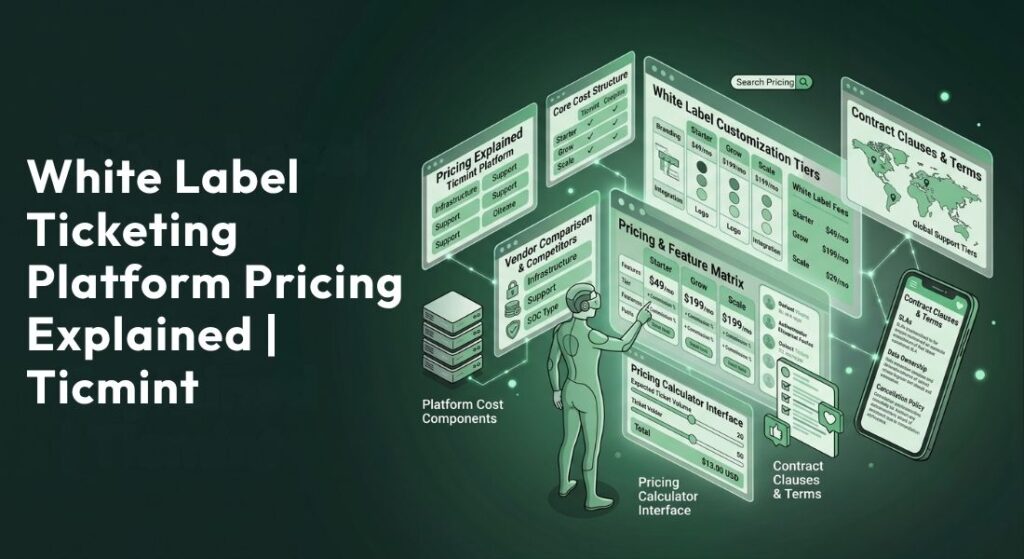
White Label Ticketing Platform Pricing: What Organisers Get for Their Money
Overview
Every ticketing platform quotes a headline fee. Very few tell you what that fee actually buys, or what it quietly costs you in data, payout timing, and brand equity across a full season of events.
This guide breaks down white label ticketing platform pricing in plain terms: the three fee models on the market in 2026, what’s genuinely included versus billed as an extra, the hidden costs that erode margin, and how to work out your true cost before you sign anything.
It matters because the wrong pricing shape scales against you. At the Yonex-Sunrise India Open 2026, organisers running on owned white-label infrastructure recorded a 27% year-on-year revenue lift and 3X marketing ROAS (Ticmint, 2026). That is the kind of outcome a per-ticket marketplace fee actively works against.
What Does a White Label Ticketing Platform Actually Cost?
White label ticketing platform pricing is the total cost of selling tickets under your own brand: usually a per-transaction percentage, a flat per-ticket fee, or a subscription, plus payment processing. Unlike a marketplace, a true white-label price should include full branding and attendee-data ownership rather than charging extra to unlock them.
The sticker number is only the first line of the bill. As a result, two platforms quoting “3%” can land in very different places once payouts, add-on modules, and data terms are counted. The rest of this guide separates the quoted fee from the real one.
The Three Pricing Models and Where the Money Really Goes
Almost every provider uses one of three shapes. Each behaves differently as your events grow, so the best fit depends on your average ticket price and volume.
Model | Typical structure | Scales well when… | Watch out for |
|---|---|---|---|
Percentage of transaction | 2% to 5% of ticket value + processing | Tickets are low-to-mid priced | Cost rises with every successful sale |
Flat per-ticket fee | Fixed fee per ticket + processing | Ticket prices are high | Fixed fees hurt on cheap or free tickets |
Subscription / licence | Monthly plan or one-time licence, low or 0% per ticket | High volume, recurring events | High base cost before you sell anything |
For example, a percentage model rewards you on a low-priced community event but taxes you on a premium one. In contrast, a flat per-ticket fee does the opposite. This means the “cheapest” platform is entirely a function of your own event mix, not a universal ranking.
Percentage-of-transaction (marketplace-style)
The fee is a share of every sale. It feels small on one ticket and compounds fast across a sold-out venue. Consequently, this model penalises exactly the events you most want to grow.
Flat per-ticket fee
A fixed amount per ticket, regardless of price. Predictable, but brutal on low-value or free registrations where the fee can dwarf the ticket.
Subscription or one-time licence
You pay for the platform, then keep most or all of the transaction. Furthermore, this shape aligns the vendor’s incentive with predictable software value rather than a cut of your growth.
What's Included in White Label Ticketing Platform Pricing (and What's Extra)
This is where most of the real money hides. The single question that decides value: is the white-label capability bundled into your plan, or billed as an add-on once your event succeeds?
Capability | Should be included | Often billed extra elsewhere |
|---|---|---|
Branding removal / custom domain | ✅ Included | Locked behind a higher tier |
Branded confirmation emails + QR tickets | ✅ Included | Per-module upsell |
Attendee-data ownership + export | ✅ Included | Restricted or platform-owned |
Bring-your-own payment gateway | ✅ Included | Forced processor, no choice |
Real-time analytics | ✅ Included | Premium reporting tier |
On-site scanners / kiosks / badge printing | Rental, if needed | Per-unit, per-day charges |
Custom integrations / SSO | Enterprise scope | Separate line items |
If a feature is free on a small event and expensive on a successful one, it is not a feature; it is a tax on winning. Similarly, “complete customisation” and “instant setup” claims deserve scrutiny: proper white-label configuration (DNS, SSL, email authentication) usually takes one to two weeks.
Hidden Costs in White Label Ticketing Platform Pricing
The quoted rate rarely covers the full picture. In addition to the headline fee, four costs routinely surprise organisers.
- Post-event payout holds. If a platform holds your revenue until after the event, you are effectively giving it an interest-free loan of your own money while you fund deposits from elsewhere. Direct payouts on a rolling schedule remove that gap.
- Branding-removal upsell. Your own event page carries someone else’s logo until you pay to remove it.
- Hardware and on-site modules. Scanners, kiosks, and badge printing charged per unit per day, which adds up across a multi-day, multi-gate event.
- Data limits. A basic export that still lets the platform remarket your attendees to competing events.
That last one is the expensive one. This means the true cost of a marketplace is not only the fee; it is the audience you never get to keep. For refund and payout mechanics on Ticmint, see the cancellation and refund guide.
The ROI Case: What Organisers Get Back
Cost is only half the equation. The return comes from owning the relationship, the data, and the payout timeline. For example, a marketplace fee of roughly 3.7% plus a per-ticket charge can hand a platform $8,000 to $15,000 on a single $100,000 event, money that funded none of the planning, promotion, or delivery.
Owned infrastructure compounds in the other direction. Every buyer becomes a contact you can reach for early-bird offers, upsells, and the next event, rather than an audience you rent once and lose. Ticmint’s own deployments show the pattern: 13,062 tickets and a 27% year-on-year revenue lift at the Yonex-Sunrise India Open 2026, and 3.1X revenue year-on-year at Peak Longevity Fest Dubai 2026 (Ticmint, 2026). Across the platform, that adds up to $41M+ in transactions over 1,600+ events in 138 countries.
White Label Ticketing Platform Pricing at Ticmint
Ticmint is priced to reward growth rather than tax it. As of 2026, transaction fees start at 2%, which can run up to 35% below the industry-standard marketplace rate, with full white-label included rather than sold as an upgrade.
- Fees from 2%. No per-ticket surcharge stacked on top, so cost stays proportional as you scale.
- White-label built in. Custom domain, branded checkout, confirmation emails, and QR tickets. Attendees never see “Ticmint” unless you want them to.
- Bring your own payment gateway. Razorpay, UPI, Stripe, Revolut, Apple Pay and more. Set your own buyer fees and get paid on your timeline, with no forced processor and no post-event hold.
- Data ownership. Every contact is yours to export and remarket, not the platform’s.
- Regional entry pricing. From ₹249/month (India), AED 59/month (UAE), and £19/month (UK) for self-serve organisers.
- Enterprise-grade trust. SOC 2 and ISO 27001, a dedicated account manager, and custom integrations for high-volume operators.
Self-serve organisers can launch a branded page in minutes; sports federations, venues, and multi-day festivals sit on the enterprise event ticketing platform, where full white-label is included at no extra charge and pricing is scoped to transaction volume. You can review the full enterprise offer on the enterprise ticketing solution page.
How to Calculate Your True White Label Ticketing Platform Cost
Before comparing quotes, model your own numbers. A useful working formula:
True cost per event = (transaction % × gross ticket sales) + (per-ticket fee × tickets sold) + add-on modules + on-site hardware + cost of delayed payout + value of lost attendee data
Run it against your real event mix, not a vendor’s best-case example. In particular, price the last two terms, because most comparisons ignore them and they are often the largest. As a result, a platform that looks 1% cheaper on paper can be materially more expensive once payout timing and data ownership are counted.
Frequently Asked Questions (FAQs)
1. How much does a white label ticketing platform cost?
White label ticketing platform pricing typically follows one of three shapes: a per-transaction percentage (often around 2% to 5%), a flat per-ticket fee, or a subscription, plus payment processing. Ticmint’s fees start at 2% with white-label included, so the branded experience is not a separate charge on top of the base rate.
2. Is a white label ticketing platform worth the price?
For recurring events, premium ticket prices, or any brand you plan to build over time, yes. The return comes from owning attendee data and repeat sales rather than renting an audience once. Ticmint organisers recorded a 27% year-on-year revenue lift at the India Open 2026 (Ticmint, 2026) on owned infrastructure.
3. What percentage do ticketing platforms take in fees?
It varies widely. Marketplace platforms commonly charge around 3.7% plus a per-ticket fee, while owned white-label platforms can start far lower. Ticmint begins at 2% per transaction with no per-ticket surcharge, which can work out up to 35% below the industry-standard marketplace rate depending on your ticket price and volume.
4. Are there hidden fees with white label ticketing platforms?
Often, yes. Common extras include paying to remove branding, per-day hardware rental, premium reporting tiers, and post-event payout holds that tie up your revenue. A genuine white-label price includes branding, data export, and gateway choice as standard, which is how Ticmint’s plans are structured.
5. Do I keep my own ticket revenue on a white label platform?
On a true white-label platform you connect your own payment gateway, so ticket revenue lands in your account on the normal rolling schedule rather than being held until after the event. With Ticmint you set your own buyer fees, choose your processor, and get paid on your own timeline, with no forced processor lock-in.
6. How much does Ticmint charge for white label ticketing?
Ticmint’s transaction fees start at 2%, with self-serve plans from ₹249/month in India, AED 59/month in the UAE, and £19/month in the UK. Full white-label, meaning custom domain, branded checkout, and emails, is included rather than an add-on. Enterprise pricing is scoped to transaction volume for high-volume organisers.
7. Is white label ticketing more expensive than a marketplace?
Usually the opposite, once the full bill is counted. A marketplace fee of roughly 3.7% plus a per-ticket charge can exceed a 2% white-label rate, and it also keeps your attendee data. On a $100,000 event, marketplace fees can reach $8,000 to $15,000 that funded none of your event.
See What You'd Pay with Ticmint
Model your own event mix against the formula above, then get an exact number. Explore the enterprise event ticketing platform for volume-scoped pricing, or start a self-serve branded page and see the fee on your first event. Setup guidance lives in the Ticmint help centre.
Want to see how Ticmint works for your event?
Talk to our enterprise team. Most clients are live within 2–4 weeks.
Running events?
Build experiences people remember, and own every part of it.
- Your brand, your experience- fully white-labeled
- Save up to 35% on platform fees
- Own your data-audience, revenue & insights, all yours
This will redirect you to WhatsApp chat 🙂
Subscribe to our newsletter
Get fresh ideas, expert insights, and actionable strategies for memorable events, delivered straight to your inbox!